This presentation really did help my understanding of the Navy and although I don't want to join I'm glad to know what my sister have to look foreward to. I will always remember what he said about Thialand though, how it's just like Hangiver 2. I would have never of guessed that Thailand wa one big party town.
Friday, March 22, 2013
Navy
Today in class somone very familiar came in to talk to us, it was Petty Officer Christopher Allen, and Wakser. Wearing their navy outfits they talked to us about the navy. I found it really insteresting because Petty Officer Allen was a recruiter and is always in the cafeteria recruiting people to come and join. He even recruited my sister Savannah, and just this Tuesday she left for boot camp. I was looking foreward to this just to know about what she'll be doing. He talked about all the different places he was able to travel to like Thialand, and also talked about the different jobs their are. Basically theirs jobs for anything in the Navy and how if you any afford college the Navy is a great choice. Officer Wakser work on the submarine for a while and helped the captain. Allen was able to be on a ship and still do what he lived to do, which was surfing.

This presentation really did help my understanding of the Navy and although I don't want to join I'm glad to know what my sister have to look foreward to. I will always remember what he said about Thialand though, how it's just like Hangiver 2. I would have never of guessed that Thailand wa one big party town.
This presentation really did help my understanding of the Navy and although I don't want to join I'm glad to know what my sister have to look foreward to. I will always remember what he said about Thialand though, how it's just like Hangiver 2. I would have never of guessed that Thailand wa one big party town.

Whales
Today we did a lab where we got a whole bunch of pictures of whale tails, and then we had to match about 5 of them to the exacted whale. At first I thought this would be easy but it was alot more difficult than I thought it would be. It had alot if older pictures of the whale and some I the matches didnt even look alike, I think it would have been alot easier if the pictures were covered and not as blurry. This lab is actually used in really life for scientist though. They use these flukes to identify whales after years, months, or even just weeks. These are important because we use these pictures as almost a database and experiment to watch the whales life and know there living habits.


Having these pictures helps us know for one thing the whale is still alive and also know that it's stays in the same area or doesn't. Whales are magnificent creatures and day to day we try to learn more and more about them. I liked this lab because it was realistic, and people out there actually do it as a job. If I have to change something it would just for the pictures to be more clear. Also maybe talk about how scientist use these and how they help.

Having these pictures helps us know for one thing the whale is still alive and also know that it's stays in the same area or doesn't. Whales are magnificent creatures and day to day we try to learn more and more about them. I liked this lab because it was realistic, and people out there actually do it as a job. If I have to change something it would just for the pictures to be more clear. Also maybe talk about how scientist use these and how they help.
Wednesday, March 20, 2013
Over fishing
Over Fushing is slowly killing our ocean because when we take out a big percentage of our ocean life then we are also take away a huge food source towards the rest of the ocean. We are also taking away fish that are endangered like the orange grouper. The orange grouper is slowly going extinct but we still choose to fish it and kill the rest of the population of them. We kill things that we have no use for such as sharks and swor fish. We can eat fish we just need to eat things that has a large population of such as crabs and lobsters.

This is affecting our Daily life because when the ocean does so do we. Imagine the world when their is no life under the sea, no whales or no fishes. What would happen to the animals on earth who live off the animals of the sea like bears, birds, and beavers? We can change this by just making a different choice on the menu, choose the lobster instead of sword fish. We can change what we did but we have to do it quick till we kill the last orange grouper, or the last Atlantic coaster.

This is affecting our Daily life because when the ocean does so do we. Imagine the world when their is no life under the sea, no whales or no fishes. What would happen to the animals on earth who live off the animals of the sea like bears, birds, and beavers? We can change this by just making a different choice on the menu, choose the lobster instead of sword fish. We can change what we did but we have to do it quick till we kill the last orange grouper, or the last Atlantic coaster.
Friday, March 1, 2013
Pollution in the ocean
One major issue concerning the ocean, is how humans are distroying it another way by polluting it. They liter and things such as;monofilament, entanglement, plastic bags, ghost fishing, and plastic pellets. Many of these things are confused as by food of other animals and are even killing them. Or they get stuck and trapped by these nets and plastic bags, or even the six pack plastics, also killing them.
The National Academy of Sciences in the USA estimated in 1997 that around 6.4 million tonnes of litter enter the world’s oceans each year. 70 per cent of the litter eventually sinks to the sea floor. The worst-affected areas are the coastal waters of densely populated regions. And the damage is visible after a bad storm,in European waters up to 100,000 pieces of litter visible to the naked eye were counted per square kilometre on the sea floor.
One of the silent killers of the ocean are things such as ghost nets, Which are actually nets they use to fish but never reel them back in. So eventually things such as Dolphins get tangled in them and eventually kill this. Maybe sharks are not the number one threat in the ocean but maybe its Human Beings themselves.

Mangroves importance
Nusery- Which these trees long roots in the water it allows thousands of fish every where to live and be protected. Also fishman fish along mangroves just because of the all the families of fish that live in their roots.
Nutrients- Many fish live in these Mangroves not just because of the great homes they can be but also of the great source of nutrients found on the roots. The roots contain many bacteria and fungi that live of them, Which many fish use as food.
Sediment and toxins- With the long tangled up roots on these trees in helps capture sediment and keeps it from going in the ocean. It almost keeps the sea clean by capturing dirt. Along with Capturing dirt these trees also catch most toxins that are let off by land or even pushed in by the waves.
Buffersystem- These trees act as buffer systems and protects the land we harsh waves hit. They also act as a shield so excess dirt or anything doesnt mix with the water. Even when tsaumis hit they protect land from major damge.
Ecosystem- These Mangroves suppport people all over the world, many families and tribes in other countries live close to mangroves just because of the close food souce.
they give 1000s of people homes and food every where.
Mangrove Adaptions
Being trees that live in water, other the years Mangroves have made changes and adaptions to their habitat so they can survive. Mangroves are able to control the opening of their stomata pores and allows them conserve its fresh water, to survive in a saline enviroment. They also have seeds that float so the tide can act as a method to spread out plants so they dont over crowd. The Red Mangrove even has its long roots sprouting out from the trees side, so it supports the tree and hold it in place. Living in water they even hold their seeds until after it has germinated and a long, until bud is formed. When it has matured to this stage, the parent tree drops it into the water, where it stays until it finds the soil and is able to put out roots. Another adaption the mangrove has is that they are able to turn their leaves to reduce the surface area of the leaf exposed to the hot sun, which allows them to reduce water loss through evaporation so they can survive.
Pores in leaves floating root and germination
Red Mangrove roots
Weaver Ants
Scientific Name:Oecophylla smaragdina
Habitat: They live in leafy trees to prey on small insects, where they can form or "Weave" together to build their nest.
Reproduction: The queen ant will lay eggs continuously and may choose to fertilize eggs at will by using the sperm cells retained from the nuptial flight this will form female worker ants instead of males. If the fertilized eggs and pupae are well-nurtured, they could potentially become queens as well.
Prey: These ants prey on almost any small insects, even if they are larger than them. Working as a team they can attck larger preys adn bite them to death. They dont kill butterflies or caterpillars but they do suck on the sweet juice they produce.


Fun Facts!
I chose the weaver ants because i thought it was very insteresting, and almost cruel when they attacked the beetle on the video but not the caterpillar. Even when they farmed other animals just like we farm cattle, i wanted to learn more about them.
Habitat: They live in leafy trees to prey on small insects, where they can form or "Weave" together to build their nest.
Reproduction: The queen ant will lay eggs continuously and may choose to fertilize eggs at will by using the sperm cells retained from the nuptial flight this will form female worker ants instead of males. If the fertilized eggs and pupae are well-nurtured, they could potentially become queens as well.
Prey: These ants prey on almost any small insects, even if they are larger than them. Working as a team they can attck larger preys adn bite them to death. They dont kill butterflies or caterpillars but they do suck on the sweet juice they produce.


Fun Facts!
- Their nest can be any where from the size of a mans head, or a mans fist.
- These ants are quite useful and are even bought from Chinese and Southeast Asian citrus orchards, to help get rid of pest.
- They create their nest by lightly squeezing their larvea to produce stick larval silk, to hold nest together.
I chose the weaver ants because i thought it was very insteresting, and almost cruel when they attacked the beetle on the video but not the caterpillar. Even when they farmed other animals just like we farm cattle, i wanted to learn more about them.
Sunday, February 24, 2013
Mangroves
Black White
Mangroves are very important expecially for the coast lines, they protect them from wave action because they hold the soil together and prevent coastal erosion. Also after many and many have grown they create almost like a forest and is home to many creatures. Mangroves even have many fish living by them almost like a fish nursery. With these mangrove forest they help fishermen easily catch fish. We should protect Mangroves because they have many benefits and actually these forest along the shoreline saved lives in 2005 when the tsunami hit Asia. There were no deaths in the areas which had mangrove forests, compared to those areas without, which suffered massive causalities.

Tuesday, February 19, 2013
Saltwater Crocodile
Saltwater Crocodile
Crocodylus porosus
These Crocodiles live throughout the seasons in different places. They generally spend the tropical wet season in freshwater swamps and rivers, moving downstream to estuaries in the dry season, and sometimes travelling far out to sea. Any type of Crocodile is a carnivore and a dangerous predators in the waters, So they need special adaptations in order to help them hunt. One adaptation of saltwater crocodiles is that their eyes and nose are high on its head so that it can remain mostly underwater, hiding from its prey. Also their broad tails and specially webbed feet help them swim and maneuver quickly. With these two adaptations they can hide but also can easily jump up or to the side to catch their prey.Saltwater crocodiles are extremely dangerous resulting in several attacks to humans annually, sometimes resulting in death. We make crocodile leather, that is in high demand, and crocodile farms are establish to raise crocodiles solely for their hides. Like other animal skin and fur trades, this practice is highly controversial among those concerned with animal welfare. But all in all these reptiles are not yet officially threatened, however in many countries populations have declined significantly. I chose Saltwater Crocs because I remember always going down to swamps where my dad use to live and they would just pop their heads up and they always scared the heck out of me and I thought it would be cool to learn more about these deviled eyes creatures.
Ocean Acidification
Ocean Acidification is the ongoing increase of PH in earths ocean. It's when dangerous amounts of carbon dioxide is affect the sea and causing life under the sea to suffer from it. Its second to Global Warming, and is polluting our seas to a point where it will take 1000s of years to recover it. Because of the excessive use of energy human race is using, such as Factory pollution, not renewable energy cars, and other things our ocean is suffering badly. It is causing planktons to actually die because they are having to use more energy to create their shells, instead of using the energy on other important task they have. Also the dangerous amounts of carbon dioxide in the ocean water is actually eating away the planktons and other shell fish's shells, causing them to die.
Carbon dioxide is actually healthy to have everywhere around earth even the ocean but when it gets to a dangerous level that's when it starts to make permanent damage to our earth. The human race can stop and help repair our earth by simply being more aware. Learn how to get energy naturally, such as more windows and solar power. And hopefully eventually we can replace gasoline engine cars with plug in cars. If we keep over abusing our earth the way we have been our ocean will be almost completely dead in the next coming century.

Thursday, February 14, 2013
What I Learned About Plankton

At first when I learned about plankton I thought it would be very boring but actually when we started to watch videos of actual footage about them I learned there's a lot more interesting thing I am swimming in when I go to the beach. For one thing I learned there are 2 different types of plankton, zooplankton, and phytoplankton. Zooplankton are plankton that actually end of being animals while phytoplankton are more like plants. One thing I thought was the most interesting was that these things are super tiny and almost needle point size. They all live as the first layer of the ocean and are 100s maybe even thousands in a cup of ocean water.
Beluga Whale
Beluga Whale!!!
Scientific name: Delphinapterus leucas
Habitat:
Tuesday, February 12, 2013
Plankton Race!
Well today we did the Plankton race and it was a lot hard than we expected, who would have thought making something sink very slowly would be so difficult. We were given a handful of items...


sticky note, 2 toothpicks, poof ball, 2 rubber bands, straw, bubble wrap, and two other things I had no idea what they were called,
So at the beginning of doing this we were told the more simple the better, although me and my partner did not do this, we at first had trouble with actually getting it to not just float and when it finally did start to sink it sunk fast. Our finally project came out to look like...

Which, yes we have no idea if it even resembles a plankton it did a "OK" job, our average time was 6.51 seconds, after trails and trials of redoing it. And after watching other groups testing theirs we started to realize we should have really listened to the teacher when she said the more simple the better. Watching groups get 20 or more seconds by not using anything but the paper itself, and then look at what ever ours was suppose to be, we both felt really dumb founded. The most difficult part of this project I have to say was everything because at first it was to get to sink and then it was to keep from sinking to fast. But in the end it was really not even hard me and my partner just made it harder than it really was.
Harmful Algal Bloom
First off algal bloom is a rapid increase or accumulation in the population of microscopic algae the ocean. They are in both fresh water and marine environment, and they are blooming at concentrations of hundreds to thousands of cells per milliliter, depending on the severity. In most cases these algaes are not harmful unless the case is HAB, Harmful Algal Bloom. HAB are algal bloom events involving toxic or otherwise harmful phytoplankton such as dinoflagellates of the genus Alexandrium and Karenia, or diatoms of the genus Pseudo-nitzschia. They occur in many regions of the world, and in the United States are recurring phenomena in multiple geographical regions. HAB is a very serious problem in the earths ocean, the harmful effects include...
- the production of neurotoxins which cause mass mortalities in fish, seabirds, sea turtles, and marine mammals
- human illness or death via consumption of seafood contaminated by toxic algae
- mechanical damage to other organisms, such as disruption of epithelial gill tissues in fish, resulting in asphyxiation
- oxygen depletion of the water column (hypoxia or anoxia) from cellular respiration and bacterial degradation

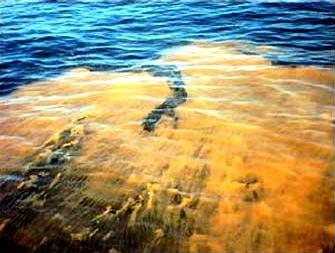
We can stop HAB by stopping pollution in the ocean, one cause of HAB is nutrient enrichment in the water. The Gulf of Maine frequently experiences blooms by an organism that produces a neurotoxin saxitoxin,which for paralytic shellfish poisoning. Also the "Florida red tide" that occurs in the Gulf of Mexico is a HAB caused by Karenia brevis, another dinoflagellate which produces brevetoxin, the neurotoxin responsible for neurotoxic shellfish poisoning.


Subscribe to:
Comments (Atom)